

Aircraft Component
Object
2026.2.2
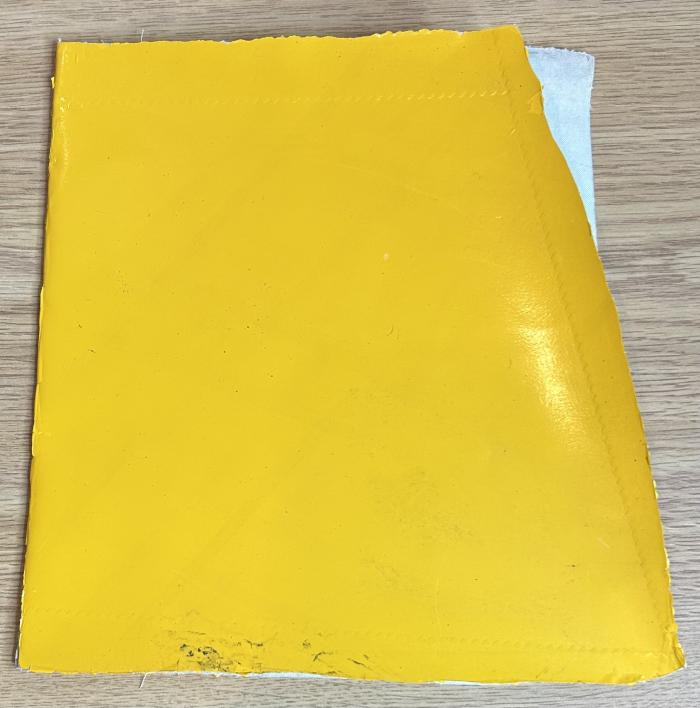
Aircraft Fabric Piece
Yellow piece of aircraft fabric, folded in half.
MISSING IN LIFE - A Yukon Aviation Mystery
On November 10, 1969 Yukon pilot Ed Hadgekiss and his 17 year- old girlfriend, Kathy Rheaume, climbed aboard his ex-RCAF Mk.II Harvard CF-XEN at the Whitehorse airport, and headed out to the coast at Skagway, bound for Pitt Meadows airfield near Vancouver.
They were never seen again. The en route weather reports along the coast were marginal at best, and not well suited to a wheel plane with no emergency options other than airfields or airports. A massive search was launched out of CFB Comox. After five weeks of plodding through abysmal, winter coastal weather, the search was called off, with no sign of the missing Harvard having been found.
On February 22, 1970, more than two months after the search had been suspended, a Wilderness Airlines charter flight which passed directly over Roderick Island, spotted the overturned Harvard high on a mountain ridge near the south end of the island. SAR crews were deployed to examine the crash site, where they found clear evidence that Hadgekiss and Rheaume had survived their violent arrival, and had camped at the wreck site for a week before striking off downhill to the coast.
Exhaustive searching of the remote, uninhabited island by ground parties turned up scant clues as to their fate: a gum wrapper, Ed's club bag, a boot, a tote bag and other miscellanea, but no trace of the two young Yukoners. Their fate remains a mystery.
In 1986 the wreck was slung off the island by helicopter, and over to private interests on the mainland. Three years later renowned author, the late Jane Gaffin, produced her best-selling book titled Missing in Life, an excellent, well researched account of this bizarre story.
The pilot's joystick removed from the wreck of Harvard CF-XEN. One can only imagine the sweaty, white-knuckled grip that Ed Hadgekiss would have had on this control column in the last seconds before plunging into the dense rain forest of Roderick Island.;Letter from Doug Banks to Bob Cameron dated April 6, 2025:
Hi Bob;
I was based at Shearwater (Bella Bella) in the summer of 1979. I had earlier overflown the Harvard and had decided on my route to climb it. I went up to the Harvard on August 17, 1979. I brought back with me the control column, the sticky W+B tape which I mentioned in our phone conversation and the gear up lever. There's a story behind each. My wife's cousin was/is an avid fan of WWII A/C. The next time I went to Vancouver I delivered the column to him. As I mentioned Dr. Jack Albrecht had this until recently when he returned it to me.
The sticky tape (included in this package) made me "feel better" about my mishap.Now however,
you say your Harvard didn't have this warning. The gear up leaver I brought back to the Hydro fellow based in Bella Bella, that made him laugh. He and partners, some years ago, bought a Mark 4 in his home town of Golden. One of the stories he told me was coming almost into the landing flare when he realized he hadn't selected "gear down". As a point of interest, Fred is now long retired from Hydro and lives in Bella Coola. He has the ranger powered F.24 and still has the remains I told you about in his back yard.
Other items were the .455 shells I found in their campfire. I'm of the opinion that the lead was twisted sideways from the shell by Ed's teeth. I'm guessing that's a tooth mark on the enclosed bullet. We all know what would have happened had the lead not been removed. Both primers, of course, were blown out. I expect they attempted to get a fire going with the gunpowder. Plus, I found the remains of probably the blind flying hood and other undetermined canvas type material. Could be I'm wrong on the tooth thing but along with many country kids we've all used our teeth to get the lead out of .22 shells, never tried it with anything bigger.
Regarding the fabric patch you will be able to spot where it was cut from when you look through the photos.
When Jack returned the control column he enclosed his correspondence file with it. I've added them in and you can decide what to discard. Like I mentioned, instead of making copies I have sent all my photos to you. The poor photos probably should be scrapped. It was a "harbour day" at the end of herring season when I returned to the site March 30, 1983. Not a good choice but an interesting climb.
Foot note: If you have seen a copy of "Lost - Unsolved mysteries of Canadian Aviation" by Shirlee Smith Matheson, it has a short chapter on the "Haunted Harvard Control column". Apparently, Dr. Jack had things go bump in the night while he was in possession of this artefact. Best to read his own account in the, above mentioned book.
Hope you find this interesting.
Cheers,
Doug / Phil (typist) ;From: "Edward Hadgkiss: Missing in Life Paperback" – January 1, 1989
by Jane Gaffin (Author)
"On November 10, 1969, Ed Hadgkiss, the Yukon pilot, accompanied by eighteen-year-old Kathy Rheaume, ran into trouble challenging British Columbia/s black-hearted coastal weather. Before reaching the destination airport, he was forced to land his Harvard trainer on a mountain ridge of remote, uninhabited Roderick Island, so evil and foreboding that it was considered taboo by the Indians. The natives believed that anybody who went into uninhabited Roderick Island would never be seen again. Over three months passed before the wreckage was spotted accidentally on February 22, 1970. Sure enough, the couple was never seen or heard from again after Hadgkiss penned a short message in the aircraft’s logbook that indicated to searchers that they were heading for the sound of the lighthouse foghorn on Finlayson Channel. Their mysterious disappearance generated a monumental search and opened one of Canada’s most intrguing missing persons’ cases of the day."
On November 10, 1969 Yukon pilot Ed Hadgekiss and his 17 year- old girlfriend, Kathy Rheaume, climbed aboard his ex-RCAF Mk.II Harvard CF-XEN at the Whitehorse airport, and headed out to the coast at Skagway, bound for Pitt Meadows airfield near Vancouver.
They were never seen again. The en route weather reports along the coast were marginal at best, and not well suited to a wheel plane with no emergency options other than airfields or airports. A massive search was launched out of CFB Comox. After five weeks of plodding through abysmal, winter coastal weather, the search was called off, with no sign of the missing Harvard having been found.
On February 22, 1970, more than two months after the search had been suspended, a Wilderness Airlines charter flight which passed directly over Roderick Island, spotted the overturned Harvard high on a mountain ridge near the south end of the island. SAR crews were deployed to examine the crash site, where they found clear evidence that Hadgekiss and Rheaume had survived their violent arrival, and had camped at the wreck site for a week before striking off downhill to the coast.
Exhaustive searching of the remote, uninhabited island by ground parties turned up scant clues as to their fate: a gum wrapper, Ed's club bag, a boot, a tote bag and other miscellanea, but no trace of the two young Yukoners. Their fate remains a mystery.
In 1986 the wreck was slung off the island by helicopter, and over to private interests on the mainland. Three years later renowned author, the late Jane Gaffin, produced her best-selling book titled Missing in Life, an excellent, well researched account of this bizarre story.
The pilot's joystick removed from the wreck of Harvard CF-XEN. One can only imagine the sweaty, white-knuckled grip that Ed Hadgekiss would have had on this control column in the last seconds before plunging into the dense rain forest of Roderick Island.;Letter from Doug Banks to Bob Cameron dated April 6, 2025:
Hi Bob;
I was based at Shearwater (Bella Bella) in the summer of 1979. I had earlier overflown the Harvard and had decided on my route to climb it. I went up to the Harvard on August 17, 1979. I brought back with me the control column, the sticky W+B tape which I mentioned in our phone conversation and the gear up lever. There's a story behind each. My wife's cousin was/is an avid fan of WWII A/C. The next time I went to Vancouver I delivered the column to him. As I mentioned Dr. Jack Albrecht had this until recently when he returned it to me.
The sticky tape (included in this package) made me "feel better" about my mishap.Now however,
you say your Harvard didn't have this warning. The gear up leaver I brought back to the Hydro fellow based in Bella Bella, that made him laugh. He and partners, some years ago, bought a Mark 4 in his home town of Golden. One of the stories he told me was coming almost into the landing flare when he realized he hadn't selected "gear down". As a point of interest, Fred is now long retired from Hydro and lives in Bella Coola. He has the ranger powered F.24 and still has the remains I told you about in his back yard.
Other items were the .455 shells I found in their campfire. I'm of the opinion that the lead was twisted sideways from the shell by Ed's teeth. I'm guessing that's a tooth mark on the enclosed bullet. We all know what would have happened had the lead not been removed. Both primers, of course, were blown out. I expect they attempted to get a fire going with the gunpowder. Plus, I found the remains of probably the blind flying hood and other undetermined canvas type material. Could be I'm wrong on the tooth thing but along with many country kids we've all used our teeth to get the lead out of .22 shells, never tried it with anything bigger.
Regarding the fabric patch you will be able to spot where it was cut from when you look through the photos.
When Jack returned the control column he enclosed his correspondence file with it. I've added them in and you can decide what to discard. Like I mentioned, instead of making copies I have sent all my photos to you. The poor photos probably should be scrapped. It was a "harbour day" at the end of herring season when I returned to the site March 30, 1983. Not a good choice but an interesting climb.
Foot note: If you have seen a copy of "Lost - Unsolved mysteries of Canadian Aviation" by Shirlee Smith Matheson, it has a short chapter on the "Haunted Harvard Control column". Apparently, Dr. Jack had things go bump in the night while he was in possession of this artefact. Best to read his own account in the, above mentioned book.
Hope you find this interesting.
Cheers,
Doug / Phil (typist) ;From: "Edward Hadgkiss: Missing in Life Paperback" – January 1, 1989
by Jane Gaffin (Author)
"On November 10, 1969, Ed Hadgkiss, the Yukon pilot, accompanied by eighteen-year-old Kathy Rheaume, ran into trouble challenging British Columbia/s black-hearted coastal weather. Before reaching the destination airport, he was forced to land his Harvard trainer on a mountain ridge of remote, uninhabited Roderick Island, so evil and foreboding that it was considered taboo by the Indians. The natives believed that anybody who went into uninhabited Roderick Island would never be seen again. Over three months passed before the wreckage was spotted accidentally on February 22, 1970. Sure enough, the couple was never seen or heard from again after Hadgkiss penned a short message in the aircraft’s logbook that indicated to searchers that they were heading for the sound of the lighthouse foghorn on Finlayson Channel. Their mysterious disappearance generated a monumental search and opened one of Canada’s most intrguing missing persons’ cases of the day."